
When Gong Shows Collide?
Making Sense of the Police Services Board Budget Scandal

It was a long time coming.
The Sault Ste. Marie Police Service (SSMPS) and its governing Board have finally faced a reckoning.
It might have been a moment to savour for advocates of transparency.
But there’s nothing to savour.
The incompetence that led to the reckoning is just too costly.
And it’s something that can be quantified...
… in millions of dollars.
Previously, I’ve written about the ‘ransomware’ attack of 2021, the politics of the police budget that just keeps ballooning, and some of the backstory on former Chief Robert Keetch’s departure.
Years ago, when a group of SSMPS officers attempted to sue a local author (Steffanie Petroni of The Northern Hoot) for reporting on an incident of excessive force, I started paying closer attention.
Thankfully, when financial mismanagement hits the headlines, everyone starts paying attention.
We shouldn’t be surprised by the recent turn of events for two reasons.

Image Credit: Wikimedia Commons (NBC Television Network)
First, signs of a looming budget crisis had been accumulating for a long time.
For years, the SSMPS Board would consistently present financial updates with vast amounts of overtime costs due to staffing pressures.
And while the Board is now relatively open about the number of its officers off duty, this problem didn’t come out of nowhere.
It’s been known for a long time, even if it’s never been publicly reported.
According to the Board, up to 20% of frontline (or sworn) members are on leave.
Out of a total of 169, that’s anywhere between 23 and 34 officers.
This estimated statistic alone is unprecedented and should be national news.
A report focused on a similar statistic in the Royal Canadian Mounted Police (RCMP) found that its numbers of officers on long-term leave increased “184 per cent over a 14-year period.”
By the end of 2024, around 7% were off work for more than 30 consecutive days due to “illness, injury or disability.”
We still don’t have full breakdown of those on leave at the SSMPS, including how many are on long-term leave.
But in comparison, the SSMPS could have almost three times the alarming RCMP statistic.
The officers that are on leave are entitled to compassion and privacy, of course.
But why are there so many of them?
This is an important question that’s not being answered and it speaks to the surface level of information we’re given.
Second, the SSMPS is probably the least transparent public institution in the city.
It recently earned a distinction in that area, and it was well-earned indeed.
I could cite countless examples but let me provide you with just one that’s relevant.
In 2021, I requested the previous agendas and minutes from the Board by submitting a freedom of information request.
To get a better sense of how the Board had operated over time, I requested 10 years of records (2010-2020).
When you request information like this, the requester is responsible for fees associated with the search, preparation, and release of the information.
I naively thought that previous Board records would be quite easy to assemble or that they had already been digitized.
I was wrong.
Instead, I had to pay $500 to get access to records that should already be publicly available.
And the joke was clearly on me.
I paid the fee thinking that the records would be complete.
Instead, they were missing most of the substance of the Board’s business and discussions.
On countless occasions, the minutes record a general statement for agenda items without any detail whatsoever, and the information that’s given to Board members is missing.
In other words, if you wanted to have a public record of what the Board was doing, you’d need to contend with incomplete and missing information.
The sometimes shoddy minute-taking is something that was recently questioned by Councillor Caputo in the wake of the budget crisis.
In a series of pointed questions put to the Board, she mentioned:
“In all of the meeting minutes throughout 2024, when budget came up it normally reads ‘chief went over report’ and then gives a comment about the chief stating that you were on target to meet budget.”
Sadly, that’s not an anomaly.
That’s just how the Board had been operating.
For a long time.
Together, these two facts (evidence of a looming budget crisis and an absence of transparency) meant that when things got bad, it was already too late.
While most of the criticism has been absorbed by the SSMPS and its Board thus far, there’s more blame to go around.
When the SSMPS Chief and Board leadership appeared at City Council for budget presentations with their hat in their hand, they would present just a handful of slides.
At one point, I directly asked someone within the City administration: is that all the financial information you’re given before authorizing a budget increase?
I was astonished to learn that what you see is what you get.
But I was even more astonished by the fact that Councillors would keep rubber stamping massive police budget increases when they’re not even presented with a complete budget.
As an aside, there’s good evidence to show that increased police budgets are much less effective in reducing crime than you might imagine.
And then there were all the departures from the Board that weren’t exactly explained publicly.
Councillor Vezeau-Allen came pretty damn close to an explanation in 2023, but what about her successor (and former police officer), Councillor Spina?
And what about Eva Dabutch?
Ontario legislation is increasingly prioritizing appointments that reflect their communities and an Indigenous woman was appointed and then disappeared without anyone even noticing?
Did they resign from the Board, and if so, why?
One of them, Councillor Spina, then spearheaded the effort to compare costs between the current municipal police service and the Ontario Provincial Police (OPP).
It was a provocation that didn’t stand a chance.
But the point probably wasn’t to explore a realistic policy option.
It was a message to the provincial government and the Board to get their house in order.
The message was well-received, I think.
Ontario’s Solicitor General, Michael Kerzner, responded with a definitive ‘no.’
Even though the Ontario government wouldn’t even entertain the possibility of the OPP taking over local policing, you better bet it’s watching closely now.
From there, the finger pointing only continued.
The two members of the Board appointed by the province, John Bruno and Ian Mackenzie, ended up resigning and citing political interference.
Among other things, they claimed that the Board not considering the rehiring of former Chief Hugh Stevenson was unfair.
To refresh your memory, Stevenson resigned from his position (during the brewing budget crisis) to be a candidate in the 2025 federal election for the Conservative Party.
Let’s deal with the main issues raised in turn.
First, has the Board been ‘politicized,’ and if so, by whom?
It’s ironic that Mackenzie argued that the Board had been ‘politicized’ when he was vocal in his support for another Conservative Party lately.
[An additional irony is the fact that some of the recipients of government funding that Mackenzie cites in his letter to the editor are connected to donations to the Ontario Progressive Conservative Party and its candidates.]
If a Board member voices support for political parties, should we consider that ‘political?’
But there’s another important detail to point out here.
Both Bruno and Mackenize were appointed to the Board by the Ontario government, and there’s a long history of appointments under Premier Doug Ford that’ve raised concerns about potential political patronage.
Both Bruno and Mackenzie appear to have donated to the Ontario Progressive Conservative Party and its candidates.
For example, Bruno was first appointed to the Board in 2015 and began his first stint as Chair the following year (candidates are often reappointed after two year terms).
And someone named John Bruno is a generous donor to the Ontario PC Party, according to publicly accessible data from Elections Ontario.
This might not be evidence of political patronage, but it might fit a broader pattern with this provincial government.
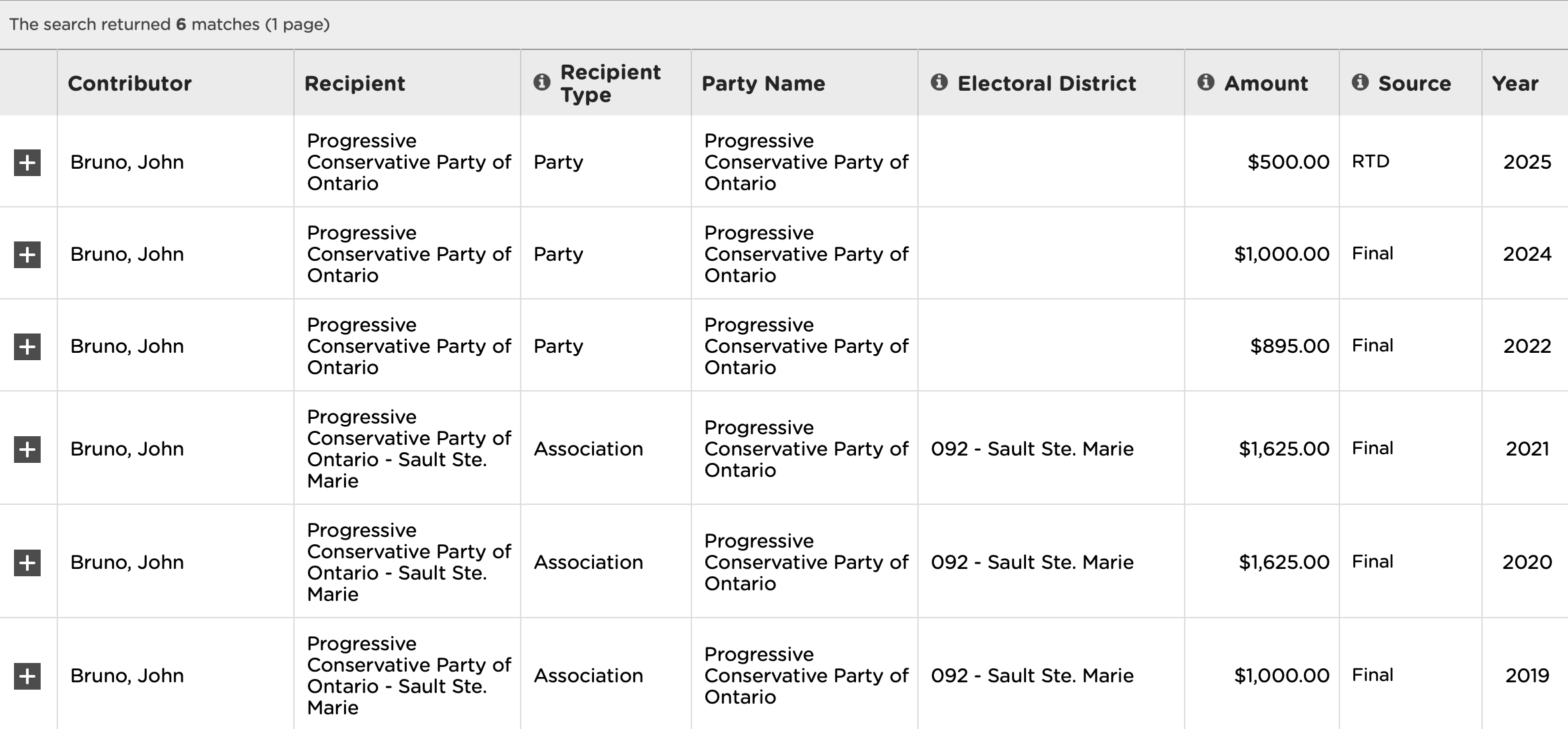
Image Credit: Elections Ontario
When Doug Ford was first elected Premier, he unsuccessfully tried to appoint his friend as the head of the OPP.
Last year, the Ontario government decided to scrap its plans for assuming more control over who’s appointed to police Boards across the province.
Ford has also been very clear about his intentions to politically interfere with the appointment of judges in the province.
Saying that a governing Board is ‘political’ isn’t a criticism.
It’s an observation, and something that should be pretty obvious.
If anyone wants to know who’s ‘politicizing’ appointments and boards, the PC Party is by far the most to blame, since they’re the ones currently in power and intent on using that power.
Second, should Stevenson get his old job back?
No, he shouldn’t.
The Board is supposed to be evaluating the performance of the Chief.
Clearly, something went wrong.
The people who perform an oversight function within that governance structure failed abysmally.
But don’t worry about Stevenson.
As far as I can tell, he’s probably already collecting a pension from his previous employer (please correct me if I’m wrong).
For reference, Stevenson made around $225,000 in 2024 from the SSMPS.
I think it’s fair to assume that he’ll be okay financially.
Alas, all is well, according to the City.
It now has two responsible stewards on the Board, with Mayor Shoemaker as Vice-Chair and Nuala Kenny (a former City Solicitor) as Chair.
The provincial government will also appoint two new members of the Board to replace Bruno and Mackenzie, and it really needs to appoint high-quality individuals this time around.
Just don’t be surprised if they’re individuals that’ve donated to the PC Party.
There’s one more wrinkle here.
Because Mayor Shoemaker is a partner with Wishart Law, he’s a perennial potential conflict of interest in municipal governance.
Remember Naomi Sayers?
Although the local media hasn’t informed you yet, she’s been legally sparring with the SSMPS behind the scenes.
Similarly, you’re not allowed to know that the alleged harasser of Sayers was Orrette Robinson, who sadly died in a motorcycle accident in the fall of 2023.
The misconduct investigation obviously disappeared but associated legal proceedings remained.
According to Sayers, a lawyer with Wishart once threatened to sue her.
So, here’s another important question: how will Mayor Shoemaker serve on the Board if his law firm carries cases associated with the local police?
I’m sure someone will ask about this at the next Board meeting.
The SSMPS budget scandal is a sobering lesson for municipal governance.
But that’s what happens when gong shows collide.
Transparency isn’t just a courtesy to the public.
It’s absolutely required to make good (and fiscally sound) decisions.
If the City of Sault Ste. Marie truly wants transparency, it can start with a forensic audit of the SSMPS.
*The original version of this post erroneously mentioned that Stevenson was a candidate in the most recent provincial (not federal) election. It has since been amended.*